A Guide to Conditional Call Forwarding
What is conditional call forwarding and how to set it up. Forward calls when busy, unanswered, or unreachable on any carrier.
Imagine you have a helper who answers your phone, but only when you can't. That’s how conditional call forwarding works. It's a smart tool that sends calls to a new number only at certain times. This happens when you’re on another call, don’t answer, or your phone is off.
What Is Conditional Call Forwarding?
Think of conditional call forwarding as a smart traffic cop for your phone. It doesn't send every call to the same place. First, it checks when you can take the call. If you are free and you answer, the call comes right to you.
But if you can't answer, it sends the call to a backup number. This could be your office phone, a coworker, or a robot helper. This is great for small business owners who are always busy. It makes sure a customer never gets sent to voicemail just because you were on another call. This is a key part of good call management, which is about handling business calls like a pro.
How It’s Different From Regular Forwarding
The big difference is the word conditional. Regular call forwarding sends all of your calls to another number, all the time. Your main phone won't even ring. Conditional forwarding is smarter. It only works when it needs to.
This smart routing is the real magic. It lets you take the calls you can and gives you a safety net for the ones you can't. You never miss an important call.
Conditional call forwarding is a key feature in any better business phone system. To help you choose, let's look at them side-by-side.
Conditional vs. Unconditional Forwarding
This table compares the two types of call forwarding. It helps you see which one fits your needs.
| Feature | Conditional Call Forwarding | Unconditional Call Forwarding |
|---|---|---|
| When It Works | Only when you are busy, can't answer, or your phone is off. | All the time, for every call. |
| Your Phone's Behavior | Your phone rings first, so you can try to answer. | Your phone does not ring at all. |
| Best For | People who want to answer calls but need a backup. | People who want all calls to go to a different number. |
| Main Goal | To catch calls you would otherwise miss. | To send every call to another line. |
Choosing between them is about how you work. Do you want to be the first person to answer, with a backup plan? Or do you need every call handled by someone else?
How The Three Forwarding Rules Help Your Business
The best part of conditional call forwarding is its three simple rules. Each rule is a safety net for a different problem. They make sure you never miss a customer just because you're busy. It helps you stay connected and look professional, no matter what happens.
For a small business, every call is a chance to get a new job or help a client. By 2025, about 81% of users were using features like this to handle their calls. And 86% said avoiding missed calls was the top reason. This shows how much this simple phone setting can help a business.
When Your Line Is Busy
Say you’re a roofer on the phone talking about a big job. A new customer calls to ask for a price. Without this tool, they would get a busy tone or go to voicemail. You could lose that new customer.
But with the "When Busy" rule on, the new call is sent to another number you picked. It could go to your office manager, a partner, or an AI helper. The customer gets help right away, and you get a new lead without hanging up on your first call.
This chart shows how these rules handle every call.
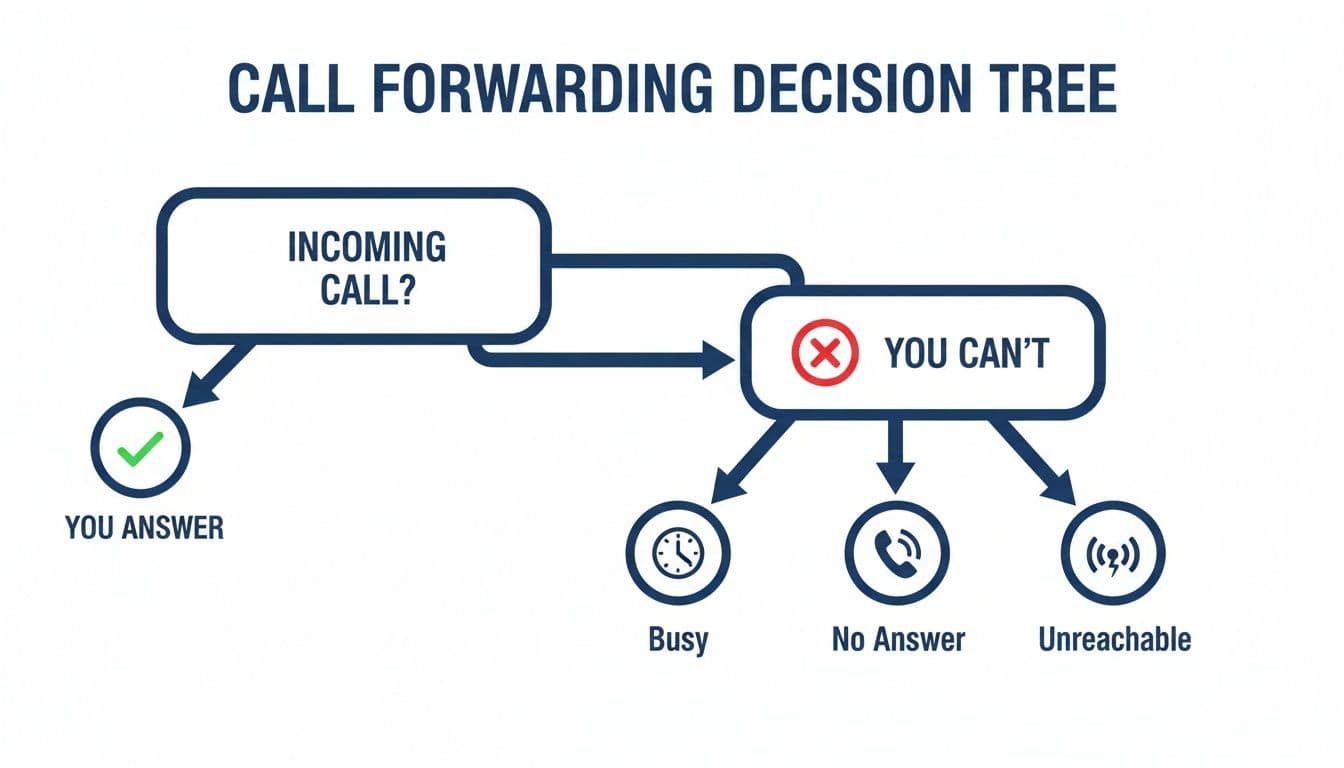
The point is simple: for every call you can’t answer, a rule is ready to help.
When You Cannot Answer
Now, think of a repair person on a ladder in a hot attic. Their phone rings with an urgent call. Answering is not just hard; it’s unsafe. This is where the "When Unanswered" rule helps.
After a few rings (about 15-20 seconds), the call is sent to another number. The customer doesn't have to listen to endless ringing. Their call goes to someone—or something—that can help right away. It keeps your business working, even when your hands are full. You can see our guide on other call forwarding options to learn more.
When You Are Unreachable
Last, think of a landscaper working on a large property with bad cell service. A good customer tries to call to add a new service, but the call won't go through.
The "When Unreachable" rule is your final backup. It works when your phone is off or has no signal. It sends the call to another line so your business is always open.
This way, even when you're off the grid, your customers can still reach your business.
Using Conditional Call Forwarding
Now that you know what it is, let's talk about how to use it. The best part is seeing how these rules solve real problems for your business. Think of them as tools to build a smarter phone system. They turn missed calls into new chances.
Here are four ways you can use this feature today. Each idea helps your small business look more professional, stay organized, and keep customers happy.
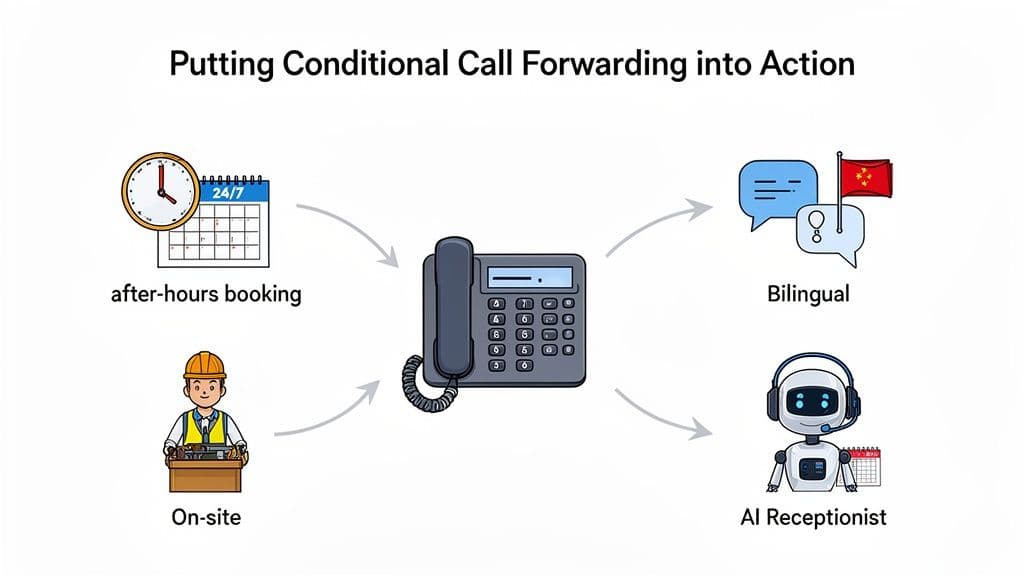
Provide 24/7 Customer Service
Your workday may end at 5 PM, but your customers might still have questions. Instead of sending calls to a plain voicemail, use the "When Unanswered" rule. Send them to a system that can help.
This system can do more than take a message. It can answer common questions, say your business hours, or text a link to book an appointment. Your business can be helpful day and night.
Safely Handle On-the-Job Calls
If you’re a plumber or electrician, answering your phone mid-job can be unsafe. Talking to a customer while on a ladder is a bad idea. This is where the "When Busy" or "When Unanswered" rules are a lifesaver.
When a call comes in, let it ring. After a few seconds, it goes to your office manager or an AI helper. You stay safe and focused. Your customer gets the help they need right away.
Serve More Customers with Bilingual Support
What if a new customer calls but speaks a different language? You might lose their business. With conditional forwarding, you can send calls you can't answer to a service that speaks another language, like Spanish.
This simple change makes your business more welcoming to more people. It shows customers you care, no matter what language they speak.
Think of a cleaning service owner who is very busy. Calls pour in while they are at a client's home. Conditional call forwarding helps by sending calls away only when busy, unanswered, or out of reach—like after 20-30 seconds of ringing.
This is a popular feature. In Europe, over 50% of businesses used these phone systems by 2023. You can learn more in this insightful article about modern phone systems.
Create a Fail-Safe for Outages
Let's be real, technology can fail. Your phone line might go down, or you might drive through an area with no service. The "When Unreachable" rule is your safety net for these times. If your phone is offline, calls are sent to a backup number.
That backup could be another cell phone, an office phone, or an AI helper. No matter what happens to your main phone, your business stays open. You won't lose a good lead because of a tech problem.
Why the Right Destination for Your Calls Matters
Setting up conditional call forwarding is a great first step. But it’s only half the job. Think of it like a mail sorter. It does a great job separating the mail. But where the mail goes is what really matters.
Sending a customer to a voicemail box is like sending a package to an empty building. The chance is lost. This is why picking the right place for your forwarded calls is a game-changer.
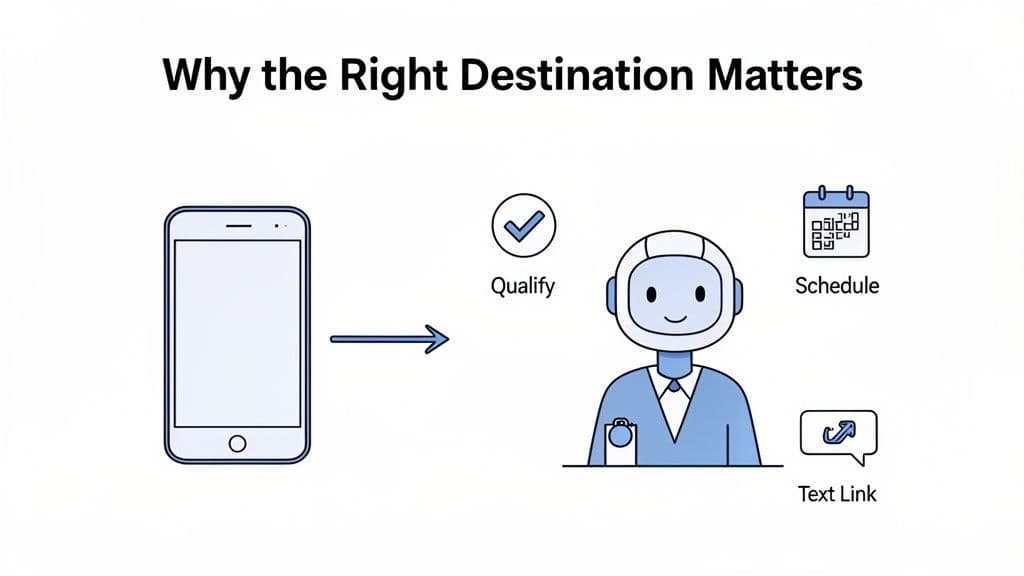
From Voicemail to a Smart Assistant
Instead of sending calls to voicemail or a costly person, what if you sent them to a smart AI helper like Cira? An AI helper is more than a message-taker. It acts as a professional front desk for your business, even when you're busy.
This small change can make your customer's experience much better. A new customer isn't told to "please leave a message." Instead, they get a helpful voice ready to help them right away, 24/7. Knowing how to send calls the right way is a key part of optimizing contact center operations.
Turning Missed Calls into Booked Jobs
An AI helper like Cira is made to turn a forwarded call into a new job. It doesn't just take a message. It works with your customers to help them—and you.
Here’s what a smart destination can do for you:
- Answer Common Questions: It can tell callers your hours or services, saving you time.
- Qualify New Leads: The AI can ask questions to see if a caller is a good fit for you.
- Send Booking Links: It can text a link to the caller’s phone so they can book an appointment.
- Schedule Appointments Directly: It can find an open spot on your calendar and book the job for you.
By sending calls to a system that can do these things, you keep your business moving.
Sending calls to a smart helper turns a simple phone tool into a way to get new leads and grow. It makes sure that even when you can't answer, your business still can.
This isn’t just about making things easy. It’s about making your business look bigger and more professional. When every caller gets a fast, helpful answer, they feel cared for. That builds trust and makes them more likely to pick you.
Common Problems and How to Fix Them
Even a great tool like conditional call forwarding can have problems. But don't worry—the fixes are usually simple. Knowing how to fix small issues will help you know your phone system is always working for you.
Let’s look at some common problems you might have. We’ll cover why calls go to voicemail too fast and what to do when forwarding doesn't work. These quick tips will help you get everything running smoothly.
Calls Go to Voicemail Too Fast
Does it feel like you don't have enough time to answer your phone? This is a common problem. The fix is to change the ring time. Most phone companies set the ring time to about 15-20 seconds.
For many people, that's not long enough. Luckily, you can often make it longer.
- Contact Your Carrier: The easiest way is to call them. Ask them to make the ring time longer before calls are forwarded. Many can change it to 30 or even 60 seconds.
- Check Your Phone App Settings: If you use a modern phone app, you might be able to change this setting yourself in the app's menu.
This simple change gives you more time to answer. It makes sure you only forward the calls you really can't get to.
Forwarding Fails When Your Phone is Off
You set up the "unreachable" rule for when your phone is off, but callers say the call won't go through. What's wrong? This problem often happens because your phone company's network is slow to see that your phone is off.
A common reason for this problem is that the setting is not turned on correctly by your phone company. It’s not a problem with your phone. It’s a problem with their system.
To fix this, you’ll need to call your phone company. Ask them to check that the "forward when unreachable" rule is set up right on your account. They can often fix it from their side.
Audio Delays or Poor Connection Quality
Sometimes, a forwarded call connects, but the sound is bad. A bad connection can make a call hard for you and your customer. This often happens when a call is sent through many networks.
Here are a few things you can check:
- Test the Destination Number: First, try calling the number you forward to. If the sound is still bad, the problem is likely with that phone line, not the forwarding.
- Check Your Signal: If you're forwarding calls from a cell phone, a weak signal can make the sound quality bad.
If the problem doesn't go away, your phone company can check to see where the connection is weak. A simple network reset on their end can often fix the problem.
Got Questions? We’ve Got Answers.
Learning about call forwarding can seem hard at first. But ideas like conditional call forwarding are simple once you understand them. Here are quick answers to questions we often hear from small business owners.
Does Conditional Call Forwarding Cost Extra?
Usually, no. For most phone companies, this feature is part of your plan. You will not see an extra cost on your bill for using it.
But, it's always smart to check with your company. The feature itself is free. But the forwarded calls might use up your plan's minutes, especially if you send them to a long-distance number. But turning it on? That's almost always free.
Can I Use Different Forwarding Numbers for Different Scenarios?
Yes! This is what makes it so useful. Most modern phone systems let you choose where calls go based on why they are forwarded.
You could set it up like this:
- If you're on another call (Busy): The new call can go to a business partner.
- If you don't answer in time (Unanswered): The call could go to an AI helper to book an appointment.
- If your phone is off (Unreachable): The call can be sent to a main office phone as a backup.
This kind of setup means every call has the best chance of being answered by the right person or system.
The power to pick a different number for each rule is what makes conditional forwarding a smart tool for your business.
Is This Really Better Than Just Sending Callers to Voicemail?
Voicemail is a dead end. It asks the customer to do all the work. They have to leave a message and hope you call back. Today, people want fast answers. A recent study found that 80% of callers sent to voicemail hang up without leaving a message.
Conditional call forwarding is about taking action. Instead of hitting a wall, your caller is sent to another person or a helpful tool. Sending them to a live person or a smart AI helper like Cira keeps things moving. They can get answers, be checked as a new lead, or even book an appointment right away.
This active method can turn a missed call into a new job. It shows you are on top of your game and builds trust from the very first call. Voicemail just can't do that.
Ready to Never Miss a Call?
7 days. Cancel anytime.
Let Cira answer your calls and book jobs while you work.